
Five Signals From Q1 That Will Shape Q2
Listen to an AI audio recording of this newsletter
Three months into 2026, one thing is clear: this is not a year that will reward certainty.
The first quarter has been full of headlines. Tariffs. Elections. AI announcements. War. Market swings. A steady stream of predictions about what will happen next.
But leaders do not win by reacting to headlines. They win by identifying the deeper patterns hiding underneath them.
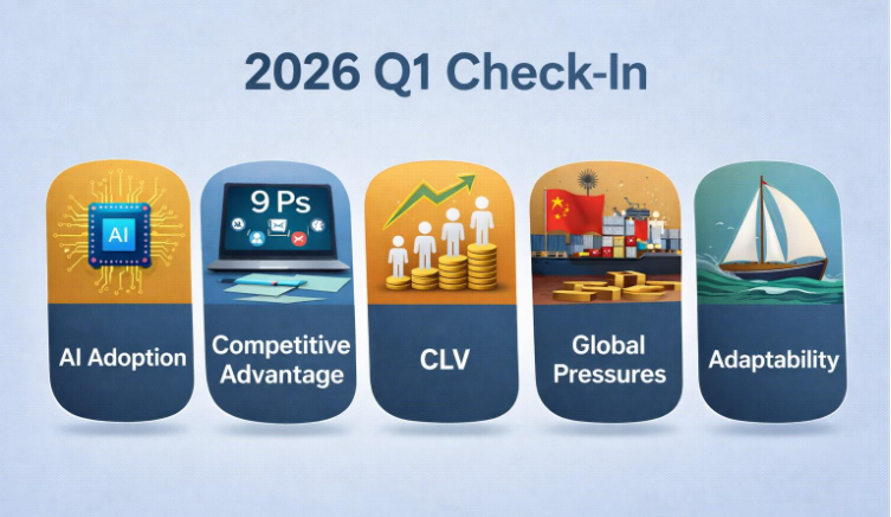
As I look back at the first quarter, I see five signals that matter more than the daily noise. Together, they tell us not only what happened in Q1, but what leaders should expect and prepare for in Q2.
The companies that move early on these signals will create distance between themselves and competitors. The companies that wait for certainty will spend the rest of the year catching up.
1. AI Became Infrastructure
For the last two years, most companies treated AI like a side project.
In Q1, that changed.
The conversation shifted from “Should we use AI?” to “Where should we build it into the business?” The leaders pulled ahead not by launching flashy pilots, but by embedding AI into the operating model itself.
The first phase of the AI era rewarded experimentation. The second phase rewards integration.
At South by Southwest (SXSW) last month, another idea became impossible to ignore: AI is no longer staying inside the screen. AI is getting hands.
The next wave is physical. AI is moving into factories, warehouses, farms, robotics, logistics networks, infrastructure, and the built environment. The strategic question is no longer only how AI changes knowledge work. It is how AI changes the physical world.
That shift matters because it creates new winners. Companies with access to data, infrastructure, and ecosystems, and the ability to orchestrate physical systems will have an advantage over companies that think AI is simply another software tool.
In Q2, expect more investment in semiconductors, data centers, power, automation, and industrial software.
The leaders in Q2 will not ask, “How can we use AI?” They will ask, “What part of our business should become impossible without it?”
2. Advantage Became Harder to Keep
At our Outthinker Miami Summit in February, one theme surfaced again and again: advantage is now in decline the moment it is created.
Every company is facing the same reality. Competitors copy faster. Technology spreads faster. Best practices travel instantly.
Which means that what matters is not simply having an advantage. It is creating a system that continuously generates new ones.
That is why the Outthinker 9 Ps framework felt so relevant last quarter.
The companies creating the most value are not relying on one source of differentiation. They are layering multiple forms of differentiation at once.
One company changes its Product. Another changes its Pricing model. Another redefines the Process. Another builds an ecosystem of Partners. Another creates a new Platform.
The strongest companies do not win because they have the best version of what already exists. They win because they create a different game.
They know who they are and what they will not do, and they build their resources around one basic idea: simple logic.
In Q2, expect differentiation to matter even more. As AI makes information abundant and answers cheap, strategy becomes more valuable, not less.
When everyone can generate ideas, the scarce resource becomes judgment.
The winners in the second quarter will be the companies that can answer three questions clearly:
- What makes us meaningfully different?
- Why will that difference matter more tomorrow than it does today?
- How will we keep reinventing that difference before competitors catch up?
3. CLV Moved to the Center
For years, most organizations have measured success using backward-looking metrics: quarterly revenue, market share, earnings, transactions.
In Q1, more leaders began to recognize that these measures tell us what happened, not what will happen.
That is why Customer Lifetime Value has become one of the most important strategic ideas of this moment.
And yet, awareness of CLV remains uneven. Marketing leaders and consumer product companies often understand it instinctively. Many C-level executives still do not, continuing to focus on revenue, market share, and quarterly earnings rather than the long-term relationships underneath those numbers.
CLV changes the unit of analysis from the product to the customer. It forces leaders to ask a different question: not “How much did we sell?” but “How valuable is the relationship we are building?”
In the first quarter, we saw companies in multiple industries begin to organize around that idea.
Retailers are shifting from one-time purchases to membership ecosystems. Manufacturers are moving from equipment sales to recurring services. Media companies are beginning to think not in terms of audience size, but in terms of lifetime value.
That idea became especially clear in the recent work I have been doing around FLV: Fan Lifetime Value. Too often, sports teams, media companies, sponsors, and brands measure fans only through their own narrow lens: ticket sales, advertising, subscriptions, merchandise. But the most valuable fans create value far beyond any one transaction. They recruit others. They amplify the brand. They create community. They deepen the value of the entire ecosystem.
The companies that understand FLV are beginning to ask a more powerful question: not simply, “How much is this customer worth to us?” but “How much value can we create together over time?”
AI will make this even more important in Q2. As companies gain better tools to predict behavior, personalize offers, anticipate needs, and connect signals across channels, CLV becomes easier to measure and maximize.
Most of us have had the experience of mentioning something in conversation, only to see an advertisement for it appear moments later in a social feed or inbox. Whether our devices are truly listening is beside the point. Customers increasingly expect companies to understand them, anticipate them, and respond in real time.
The companies that use AI to do that well will dramatically increase the lifetime value of each relationship.
The deeper the relationship, the more resilient the business.
In Q2, the companies that win will not necessarily be the ones with the biggest audience. They will be the ones with the strongest connection.
The question for leaders is not simply how to acquire customers. It is how to design a business that customers want to stay with, buy more from, advocate for, and build part of their identity around.
4. Geopolitics Became Strategy
For much of the last decade, many companies treated geopolitics as something to monitor from a distance.
Q1 made that impossible.
Trade tensions, tariffs, regional conflicts, shifting alliances, and supply chain disruption have become strategic variables. They are reshaping where companies invest, where they manufacture, where they hire, and which partnerships they prioritize.
The most important change is this: we are moving from a world optimized for efficiency to a world optimized for resilience.
As I argued last summer, uncertainty raises the cost of distance. The farther away a supplier, partner, customer, or capability is, the more vulnerable it becomes to disruption.
The old question was, “Where can we produce this most cheaply?”
The new question is, “Where can we produce this most reliably, and how close can we bring it to the customer?”
This is the logic of proximity. When the world is uncertain, organizations create advantage by reducing the distance between themselves and the people, resources, and ecosystems they depend on.
That is changing everything from manufacturing footprints to technology ecosystems.
In Q2, I expect more companies to rethink concentration risk, diversify supply chains, and build stronger regional networks. This will create opportunities for organizations that understand ecosystems.
The future will not belong to the biggest company. It will belong to the company with the strongest network.
5. The Winners Learned Faster
There is one final signal running beneath all the others.
The companies creating the most value in 2026 are not necessarily the biggest, the oldest, or even the ones with the most resources.
They are the ones learning fastest.
They are building systems that help them detect change sooner, experiment faster, and adapt before competitors do. They are creating what I recently described in Harvard Business Review as idea marketplaces: mechanisms for capturing emerging opportunities, holding onto ideas whose moment has not yet arrived, and continually reassessing them as markets, technologies, and conditions evolve.
That capability matters because the environment is moving too quickly for static plans.
The leaders pulling ahead this quarter are not treating strategy as an annual exercise. They are treating it as a living process: identifying the future, locating the barriers, generating options, and choosing where to move next.
In Q2, expect this gap to widen.
The companies that learn fastest will outperform the companies that simply execute yesterday’s plan more efficiently.
The Real Story of Q1
The real story of the first quarter is not that the world became more uncertain.
The real story is that the rules of competition are changing.
AI is becoming infrastructure. Differentiation is becoming more important and more temporary. Customer relationships are becoming more valuable than transactions. Geopolitics is becoming strategy. The ability to learn and adapt is becoming the ultimate advantage.
And underneath all of it is one larger shift: the organizations that succeed in 2026 will be the ones that can adapt faster than others while staying anchored to a clear strategic logic.
That is what I will be watching in Q2.
Not who makes the biggest announcement. But who quietly builds the capabilities, relationships, and strategic distinctiveness that compound over time.
Because in a world changing this quickly, competitive advantage alone is not enough.
The companies that win will be the ones that turn these signals into a system: using AI as infrastructure, building deeper customer relationships, creating proximity, differentiating continuously, and learning faster than competitors can respond.
In other words, the future belongs not to the companies with a single advantage, but to the companies that know how to keep creating new ones.
Stay ahead of the curve by visiting Outthinker.com and joining today.
Outthinker Networks is a global peer group of heads of strategy, innovation, and transformation at $1B+ companies who are determined to move their organizations to the next level. Members engage in curated learning, practical conversations, and networking opportunities to be more successful in performing their roles, solving their top challenges, and keeping their organizations ahead of the pace of disruption.
Authors
