
Can We Afford to Stop Too Soon?
Listen to an AI audio recording of this newsletter
“Can we afford it?”
Every business owner, executive team and board has asked the question before making an investment.
But there is another question we ask far less often: Can we afford to stop too soon?
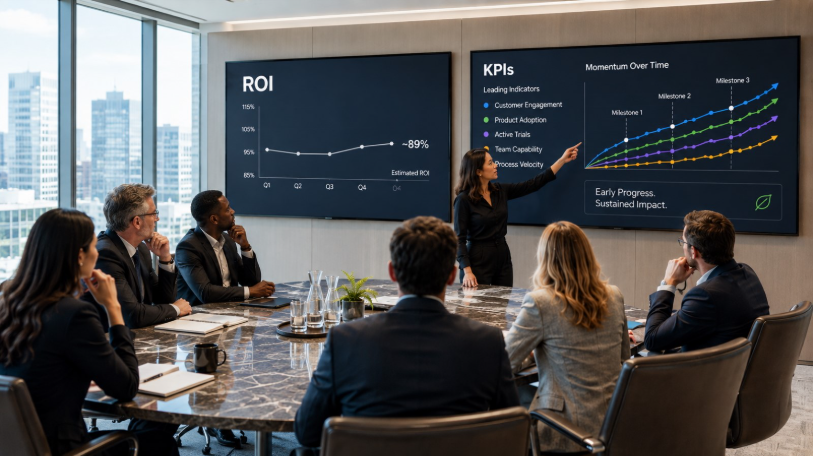
The most meaningful investments rarely produce their full return immediately. Before ROI appears, something else usually changes first.
Those changes are the KPIs that should matter.
And knowing the difference between an investment that is failing and one that simply needs more time may be one of the most important disciplines of long-term growth.
Progress Before Payoff
Think about starting a workout program.
After your first week at the gym, you probably do not look dramatically different. You may actually feel worse. Your muscles hurt. You are tired. The effort is obvious while the payoff is not.
But other things are happening.
You can run a little farther. Lift slightly more weight. Recover more quickly. Your resting heart rate may begin to change.
Those are leading indicators.
Jeff Bezos has described business results in much the same way. When people congratulated him on a strong Amazon quarter, he famously said that quarter had been “fully baked about three years ago.” By the time the financial results appeared, the decisions and investments that produced them were already years old. He was focused instead on the results Amazon would produce years into the future.
Business investments often work the same way.
A new sales capability may not produce revenue immediately, but qualified meetings may rise. A new customer experience may not improve profit this quarter, but retention or referrals may begin moving. A new technology platform may not reduce costs on day one, but cycle times, error rates or employee adoption may improve.
ROI tells you whether the destination was worth reaching. KPIs tell you whether you are moving toward it.
Measurements Matter
In The Way of Innovation, I explored an ancient Chinese framework for change that can be applied to business. Results unfold through five stages:
- Let go of what is no longer working.
- Imagine what comes next.
- Begin building it.
- Gain traction.
- Solidify the gains.
Then the cycle begins again.
This is why choosing the right KPIs matters. Each stage requires different measures. ROI mostly captures stages four and five, when results are already emerging. But sustainable growth also depends on KPIs for stages one through three, showing whether you are letting go of outdated approaches, generating new ideas and building what comes next.
Without those indicators, you may know what is working today but have no pipeline for tomorrow.
When organizations evaluate an investment only against its ultimate financial return, they create a dangerous gap between action and evidence.
During that gap, doubt grows: We spent the money. Where are the results?
The temptation is to pull back, change direction or kill the initiative.
Sometimes that is exactly what you should do. Discipline does not mean blindly continuing a bad investment.
But before making that decision, look for evidence that the underlying system is beginning to behave differently.
If you are investing in sales, perhaps the first measures are qualified conversations, proposal volume or sales-cycle velocity.
If you are developing a new product, perhaps they are customer trials, repeat usage or willingness to recommend.
If you are implementing AI, perhaps the initial return is not lower payroll expense. It may be faster decisions, more work completed per employee or fewer hours spent on repetitive tasks.
The best early KPIs sit on the path between the investment and the outcome.
They answer a simple question: If this investment is going to work, what should start happening first?
Define Progress Before Beginning
There is also a danger on the other side.
Patience can become an excuse.
There is a difference between giving an investment time to work and becoming emotionally attached to it because you have already invested too much.
The best time to make that distinction is before you spend the money.
Ask what evidence you expect to see along the way.
What should begin changing after three months? Six months? A year?
Which indicators would increase your confidence that the strategy is working?
Which would suggest that one of your assumptions was wrong?
And perhaps most importantly, how long are you willing to wait before making that judgment?
This turns KPIs into more than a scorecard. They become a decision-making system.
Maybe revenue has not arrived yet, but customer engagement is growing, adoption is accelerating and every leading indicator is moving in the right direction. Keep going.
Maybe revenue has not arrived and customers are not engaging, employees are not adopting the solution and the expected operational improvements are nowhere to be found.
That marks the difference between the company playing the long game and the one playing the short game.
The absence of ROI is not always evidence of failure.
The absence of progress may be.
Survive the Uncomfortable Middle
We live in a world increasingly designed around immediate feedback.
You click and something arrives. You post and see a response. You search and receive an answer in seconds.
That can distort our expectations about how quickly meaningful things should happen.
Building something lasting is different.
Changing customer behavior takes time. Developing talent takes time. Entering a market takes time. Building a brand, changing a culture or learning to use a new technology well takes time.
There is almost always an uncomfortable middle when the investment is real but the payoff is still mostly invisible.
That is often where good strategies die.
Not necessarily because they were wrong, but because leaders lost confidence before enough evidence had accumulated.
The challenge is resisting two equally dangerous impulses: continuing simply because you have already invested so much, and stopping simply because the return has not arrived yet.
KPIs help us navigate between the two.
They give us something to watch while we wait for ROI. They tell us whether the assumptions behind our investment are starting to become reality. And they give us evidence for when patience is warranted and when it is not.
So the next time someone around the table asks, “Can we afford it?” ask one more question: If this investment is worth making, can we afford to give it enough time to work?
Strategy takes many forms. Join Outthinker today to find the approach that moves you forward.
Outthinker Networks is a global peer group of heads of strategy, innovation, and transformation at $1B+ companies who are determined to move their organizations to the next level. Members engage in curated learning, practical conversations, and networking opportunities to be more successful in performing their roles, solving their top challenges, and keeping their organizations ahead of the pace of disruption.
Authors
