
What Is Your Leadership Brand?
Listen to an AI audio recording of this newsletter
What do people feel when you walk into the room?
Not what do they think of your strategy. Not whether they liked your presentation. Not even whether they agree with you.
What happens to their energy?
Do people sit up a little straighter? Do ideas start flowing? Do they feel more confident about what is possible?
Or do they become quieter? More cautious? Less willing to take a risk because they are trying to anticipate what you want to hear?
That feeling may be one of the most important parts of your leadership brand.
Your Brand is the Experience
We often think of a personal brand as something we construct: the words we use, the clothes we wear, the ideas we are associated with or the impression we want to project.
Leadership brands work differently.
Your leadership brand is built through hundreds of small interactions. It is what people come to expect when they bring you a problem, propose an unconventional idea, make a mistake or disagree with you.
Over time, those interactions create a remarkably durable impression.
People may forget exactly what you told them in a meeting six months ago. But they remember whether they left that meeting feeling smarter or smaller. They remember whether you listened. They remember whether their contribution mattered.
As Maya Angelou famously said, “People will forget what you said, people will forget what you did, but people will never forget how you made them feel.”
That becomes your brand.
Authentic Beats Perfect
This is where leaders sometimes confuse authenticity with image.
A few months ago, I interviewed Bill George, former CEO of Medtronic and the leadership thinker who coined the term “authentic leadership.” George has spent decades arguing that leadership is not about adopting the right style or projecting the right image. It starts with knowing who you are, what you believe and what you stand for, then having the courage to lead from those convictions. His work specifically challenged leadership models focused on charisma, image and style in favor of character, integrity and substance.
Authenticity does not mean becoming the perfectly approachable leader who always says the right thing. It means becoming more consistently yourself.
Consider Jeff Bezos. Amazon has long institutionalized an expectation of extraordinarily high standards, even acknowledging in its Leadership Principles that those standards may seem “unreasonably high” to some people.
That is not a leadership brand built around being universally liked.
It is built around a clear and consistent set of beliefs: obsess over the customer, think long term, raise the bar and expect a lot.
People know what they are signing up for.
This distinction matters. We can easily turn conversations about leadership into conversations about personality. Be warmer. Be more charismatic. Be more inspiring. Be more likable.
But history is full of successful leaders who were not people everyone would necessarily choose as a friend or neighbor.
People did not follow them because they were pleasant.
They followed because there was coherence between who the leader was, what the leader believed and where the leader wanted to go … and the followers wanted to go there too.
Authenticity creates trust because people know which version of you is going to show up.
Do You Multiply People?
But authenticity alone is not enough.
Being authentically dismissive, unpredictable or demeaning does not make someone a good leader. “That is just who I am” is not a leadership philosophy.
The better question is what your authentic leadership brings out in other people.
Liz Wiseman, who I had the pleasure of interviewing for an Outthinker podcast, captures this beautifully in her book Multipliers. She distinguishes between leaders who diminish the intelligence, energy and capabilities of those around them and leaders who multiply those qualities, drawing more from people than they may have realized they could contribute.
That may be the more useful way to think about leadership brand.
The goal is not necessarily for people to leave a conversation thinking, I really like my boss.
It is for them to think:
I know what we are trying to accomplish.
My contribution matters.
I am capable of more than I thought.
We can do this.
Good leaders make the organization feel larger because the people inside it begin operating closer to their full potential.
Last week, I interviewed Ron Johnson, the creator of the Apple Store, for an upcoming Outthinker Podcast. He worked closely with Steve Jobs to bring the concept to life. Jobs was famously demanding. But Johnson described the kind of demanding leader who made people realize they were capable of more than they thought. He raised the standard, pushed them beyond what felt comfortable and, in doing so, helped them produce work they might not have believed they could.
Bad leaders create the opposite effect. They make talented people tentative. Employees begin protecting themselves rather than proposing ideas. They stop challenging assumptions. Eventually, they contribute only what is required because experience has taught them that offering more is not worth the risk.
A few years ago, I facilitated a two-day strategy session with a CEO who created this effect at an extreme. Whenever he asked his leadership team a question, you could almost see the calculation happening in the room. They were not asking themselves, What do I think is right? They were asking, What does he want me to say?
That is what diminishing leadership looks like.
The leader may still be brilliant. The strategy may still be right.
But the organization gets smaller around them.
What Happens When You Leave?
A leadership brand is therefore not simply the reputation you want to have.
It is the effect you repeatedly have on other people.
This week, I’ll interview Constantine Alexandrakis, CEO of Russell Reynolds Associates, one of the world’s leading executive search firms. He offers a powerful test for leadership: step back and ask what would happen without you. Would the strategy and transformation you are driving continue to gain momentum, or would they stall the moment you were no longer pushing them forward?
It is another way of asking a simple question: What happens after you leave the room?
Are people clearer or more confused? More energized or more depleted? More willing to speak up or more likely to stay quiet? More capable of acting without you or increasingly dependent on your approval?
You do not need to become someone else to become a better leader.
You need to understand the best of what is already authentically you, then become more deliberate about how that shows up for others.
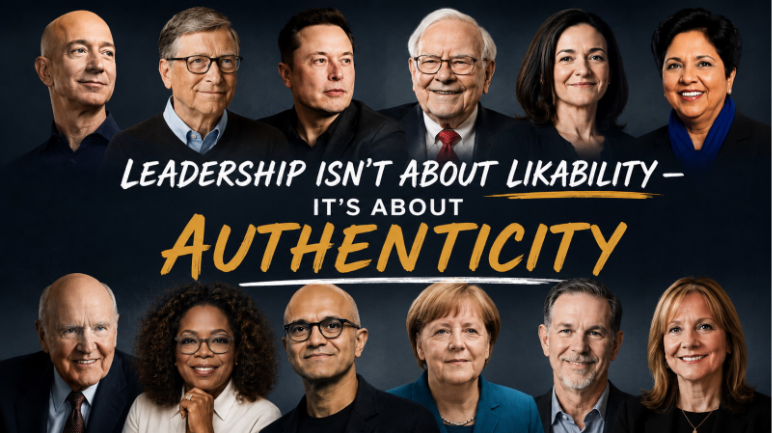
Because ultimately, leadership is not about getting people to like you.
It is about creating the conditions in which people want to come with you.
Lead more authentically. Build greater impact. Join Outthinker today.
Outthinker Networks is a global peer group of heads of strategy, innovation, and transformation at $1B+ companies who are determined to move their organizations to the next level. Members engage in curated learning, practical conversations, and networking opportunities to be more successful in performing their roles, solving their top challenges, and keeping their organizations ahead of the pace of disruption.
Authors
