
The Courage to Hit Rewind
Listen to an AI audio recording of this newsletter
One of the hardest things for a leader to abandon is not a failed idea.
It is a good idea that no longer serves the strategy.
In a recent piece, I explored what I learned from Ron Johnson, co-creator of the Apple Store, about looking beyond competitors to find growth among noncustomers. But another story Johnson shared during our conversation for an upcoming episode of the Outthinker Podcast (coming out on September 22) reveals what happens next.
Once your strategy changes, are you willing to change everything built around the old one?
When Good Work Becomes Wrong
Johnson and Steve Jobs had already spent months designing Apple’s first retail store when the strategy shifted.
Jobs began framing the Mac as the center of a person’s digital life, a hub for photos, music, movies and other devices. Johnson immediately saw the implication.
The store they had built was organized around products: laptops here, desktops there.
That no longer fit.
“If we’re going to market the Mac as a digital hub, we should build a store about photos and movies and music and the things you do,” Johnson told me.
The original store was not badly designed. It had simply been designed for the strategy Apple had yesterday.
That is the harder leadership problem: What do you do when good work becomes strategically obsolete before it ever has a chance to fail?
Jobs’ initial reaction was emphatically no. Johnson recalls Jobs was ticked off and frustrated, pointing out how much work had already gone into the store.
Then Jobs reconsidered.
As Johnson tells it, Jobs gathered the team and explained why they needed to start over: “Everything great I’ve done, I had the courage to hit the rewind button.”
Apple hit rewind.
The company delayed the stores by six months and redesigned them around the digital hub.
Strategy Should Invalidate Decisions
That story exposes a problem inside many organizations.
A leadership team announces a new strategy, then asks how its existing initiatives can be adjusted to support it.
That sounds prudent. Sometimes it is.
But if every existing project survives a major strategic shift, was the shift significant?
A real change in strategy should force leaders to revisit decisions made under the assumptions of the old one. Some projects should accelerate. Some should change. Some should disappear.
The problem is that organizations become attached to bringing initiatives to closure long before they know whether they still make strategic sense.
We have already spent the money.
The team has worked on this for a year.
We promised the board.
We have a deadline.
We are almost there.
Those arguments explain why stopping is painful. They do not explain why continuing is strategically correct.
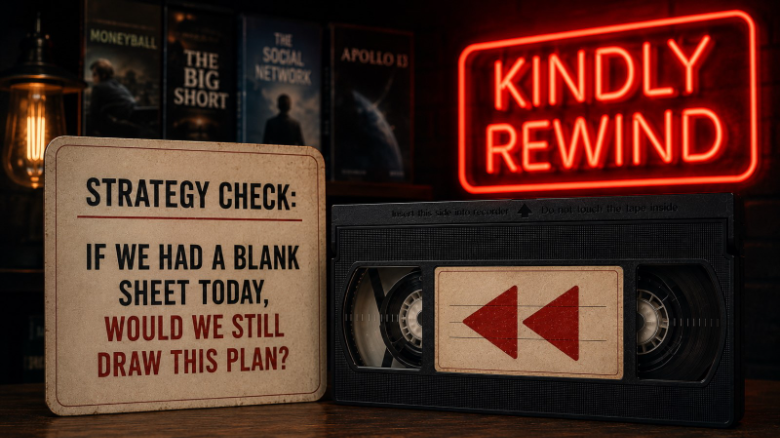
The better question is not, “How much have we already invested?” It is, “If we were starting today, knowing what we know now, would we still choose this?”
If the answer is no, finishing it may simply make the wrong strategy more expensive.
Beware the Strategic Sunk Cost
Sunk costs are usually discussed in financial terms. But inside organizations, the more dangerous sunk costs may be psychological.
Leaders invest reputation in initiatives. Teams invest months or years of effort. Careers become associated with projects. The closer something gets to completion, the harder it becomes to question it.
That is precisely what makes the Apple story powerful.
The prototype store was not failing. It had not even opened.
Apple changed course because its vision of the future had changed.
The emerging digital hub strategy meant Apple’s products were no longer the organizing idea. What people could do with those products was.
When Apple opened its first stores in 2001, that philosophy was visible. The stores included areas organized around movies, photography and music, showing customers what the Mac enabled rather than simply displaying computers.
The strategy changed the experience because the experience had to serve the strategy.
Alignment Beats Momentum
Organizations love momentum. Projects that are on time and on budget feel healthy. Progress is visible. Stopping feels like failure.
But momentum is only valuable when it is moving you toward the right destination.
Something can be beautifully designed, nearly finished and flawlessly executed and still be strategically wrong.
Johnson’s definition of strategy is useful here. Strategy, he told me, is not strategic planning. It is doing something that creates a “step change” and permanently changes the trajectory of what you lead.
A strategy capable of changing your trajectory should also be capable of changing your plans.
Otherwise, it may not be strategy. It may simply be messaging.
Know When to Rewind
Leaders are often praised for persistence. Finish what you start. Stay the course. Don’t let setbacks derail the plan.
Those qualities matter.
But persistence without strategic judgment becomes inertia.
The harder leadership skill is recognizing when new information has changed the logic behind a decision and having the confidence to act before failure forces you to.
That does not mean constantly second-guessing decisions or abandoning projects whenever a new idea appears. It means being clear about what the strategy demands and refusing to let yesterday’s investments dictate tomorrow’s choices.
Jobs could have protected the work already done on Apple’s first store.
Instead, he protected the strategy.
This wasn’t a one-off. It was part of Jobs’ operating style: hold strong convictions but be willing to reverse them when a better idea emerges. He initially dismissed the name “Genius Bar” as “idiotic,” then told Apple’s general counsel the next day to trademark it. He hated malls yet changed his mind when he recognized that malls put Apple directly in the path of the nonusers it wanted to reach.
Jobs understood that changing your mind is not the same as losing conviction. Sometimes the most strategic decision is recognizing that yesterday’s conviction no longer fits what you know today.
That distinction matters.
The goal is not to finish what you started. It is to build what the strategy now requires.
Sometimes moving forward requires the courage to hit rewind.
Join Outthinker to make the hard strategic choices, challenge what no longer fits, and discover when hitting rewind can put growth back on track.
Outthinker Networks is a global peer group of heads of strategy, innovation, and transformation at $1B+ companies who are determined to move their organizations to the next level. Members engage in curated learning, practical conversations, and networking opportunities to be more successful in performing their roles, solving their top challenges, and keeping their organizations ahead of the pace of disruption.
Authors
