
Adobe: The Future of Digital Experiences
This audio was recorded by AI:
When we launched the Outthinker List, a global recognition of companies that are redefining how strategy gets done, we did so with a simple belief: strategy is reshaped by those who see shifts early, translate them into action, and build organizations capable of evolving with the moment.
At our London Summit last month, as I presented the inaugural list, one company rose again and again in our conversations as a model of what this new era of strategic agility looks like.
While Adobe’s stock price has underperformed over the past 12 months, the long view on its fundamentals tells a very different story. For fiscal year 2024, Adobe reported revenue of $21.51 billion, representing approximately 11% year-over-year growth. Over the last five years, Adobe has added more than $10 billion in annual revenue, outperforming 88% of companies in its industry. During this same period, Adobe also surpassed most peers in book value growth and earnings per share (EPS) expansion, demonstrating a powerful combination of strategic clarity, disciplined execution, and long-term value creation.
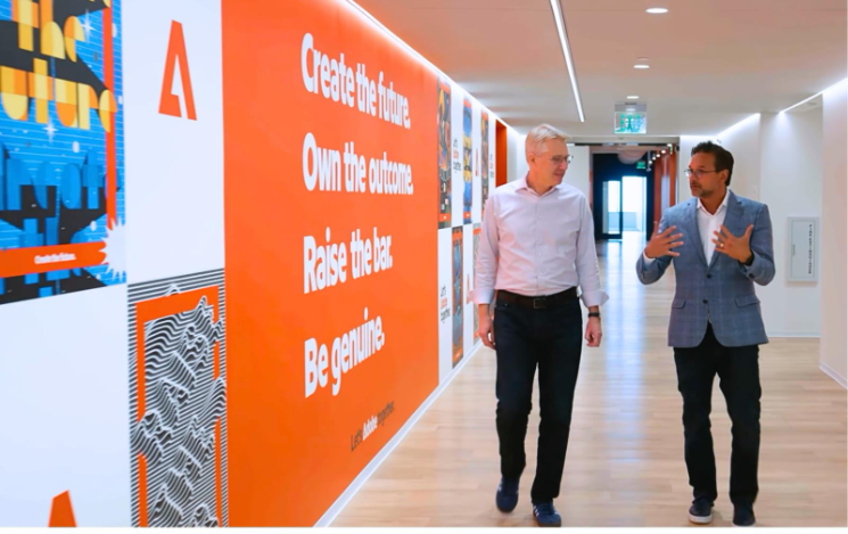
Not just because of what they build, but because of how they build, how they listen, learn, and continuously reinvent. So when I flew out to Adobe’s offices to record a conversation with Malte Bernholz, Adobe’s Vice President of Corporate Strategy and Incubator, I arrived with admiration. I left with conviction. Adobe isn’t just keeping pace with the future of creativity and digital experiences; they’re helping define it.
Company Built for the Creative
Before diving into AI, platforms, and strategy, Malte and I started where all great strategy conversations start: with the human story.
“If you really know me,” he said, “you know that photography is part of my life. It’s my creative outlet.”
His father traveled the world with a Leica camera. Malte inherited not just the camera, but the impulse to create, to interpret, to see. And that personal thread matters because it reveals something foundational about Adobe. This is a company built not only to serve enterprises or marketers or productivity workflows. At its core, Adobe is built for creatives: for people who imagine before they implement.
“Creativity is at the heart of everything,” he reminded me. “About half of our business is around creative tools … and another big part is digital experiences.”
Adobe sits at the intersection of creativity and enterprise, vision and execution. And as the world reshapes itself around AI, that intersection is becoming the strategic battlefield.
The Age of AI
When I asked Malte about the trends shaping creativity and digital experiences, he didn’t hesitate when he said, “AI is the one thing influencing everything right now.”
As we talked, one thing about AI became very clear: AI lowers the floor. It makes it easier for anyone, like marketers, students, small-business owners, to create content, generate variations, adapt formats, and get work done quickly.
AI also raises the ceiling. It gives superpowers to creative professionals: deeper control, higher sophistication, more surface area to express original ideas.
As someone who studies innovation patterns, I loved the duality of this framing. Lower the floor, raise the ceiling. Broaden access, deepen mastery. It’s the ultimate democratization story paired with the ultimate excellence story.
Critically, Adobe sees this not as a threat to creative work, but as an expansion of it.
“I don’t think there’s a threat to jobs,” Malte said. “People will be busier than ever. We’ll tackle the tedious tasks first, so people spend more time actually being creative.”
AI doesn’t replace creativity. It replaces the barriers to creativity. And that opens the door to the next frontier.
Personalization at Scale
We explored how AI enables something that brands have long dreamed of: true personalization at scale.
Brands can finally tailor every experience, including websites, messages, and product imagery, to the individual viewer. Not in a creepy, hyper-targeted way, but in a way that aligns relevance with respect. Malte described a future in which:
- Content adapts on the fly
- Experiences shift based on context and intent
- Websites become agentic: dynamic interfaces that learn, respond, and guide
“The fabric of the internet is evolving,” he said. “We’re starting to talk about the agentic web.”
As he spoke, it was clear: Adobe doesn’t just build tools; it builds the canvas upon which brands and customers meet.
But this personalization raises an important philosophical question, one I posed to Malte: If every experience is personalized, what is a brand?
His response was profound: “A brand, like a person, behaves differently with different people. But it’s always itself.”
That’s the heart of modern strategy: variation without losing the underlying identity.
Not Just Adaptive, Directional
One thing I admire about Adobe is its ability to hold opposing ideas simultaneously. In strategy, we call it ambidexterity.
Malte articulated it beautifully when he said, “You need to react very quickly … but also force yourself to have a long-term view. You need a clear vision and a clear North Star.”
This dual capability to experiment rapidly while orienting around a stable vision is a hallmark of Outthinker List companies. It’s why they outperform peers. They are not merely adaptive; they are directional.
And that brings us to perhaps the biggest strategic move Adobe has made in the AI era.
Adobe’s Four-Layer AI Strategy
When many companies think about AI, they think about models. Adobe thinks in systems.
Malte laid out Adobe’s AI strategy across four layers:
- Apps & Interfaces – where users experiment and create
- Agents & Orchestration – coordinating intelligent behaviors
- Models – including Adobe’s proprietary Firefly models and integrated third-party options
- Data – unlocking first-party enterprise data safely and responsibly
“We decided early on to develop our own models,” he explained. “But now we also include third-party models … to give customers the best model for the job.”
This flexibility, when paired with Adobe’s “commercially safe AI” stance, creates trust. And trust, as Malte reminded me, is a strategic asset.
Commercially Safe AI
For a strategy to produce differentiated results, it usually must arrive at uncommon conclusions. Agility is not simply flowing with the capricious opinions of the markets and experts; that destines you to mediocrity. It takes reading the patterns and making a commitment to a future. That is what Adobe is doing by executing into the space of “commercially safe AI.”
In a world where generative models often rely on scraped or unlicensed content, Adobe took a principled stance. “We train our models only on data we have full rights to,” said Malte. “You can rest assured you’re not infringing on anyone’s rights.”
For enterprises, this is not a preference. It is a requirement. Brand safety and IP integrity are non-negotiable.
This is another hallmark of Outthinker List companies: they don’t wait for regulation to force responsibility; they build responsibility into the product.
Institutionalized Innovation
As we discussed organizational agility, Malte pointed back to the moment Adobe shifted from packaged software to subscription, which was a bold strategic move that required “burning the boats.”
That legacy gave Adobe the confidence to evolve again when AI arrived. One mechanism accelerating this evolution is Adobe’s internal incubator, a program that empowers small teams to operate with entrepreneurial autonomy using YC-style iteration loops: build → talk to users → repeat.
“We incubate ideas that are on the edge—ideas that might become the center in the future,” said Malte.
The results speak for themselves. Several early incubator concepts are already illustrating how Adobe is redefining creative and digital experience workflows:
- Brand Concierge: an agentic shopping interface that reimagines how customers navigate, discover, and engage with products
- Firefly Boards: a visually rich, endlessly collaborative ideation environment designed to accelerate creative thinking
These are not experimental side projects. They are early indicators of Adobe’s next strategic horizon, where intelligence, creativity, and user experience converge to open entirely new categories of value.
Shifting from Products to People
In March, Adobe made another bold organizational move by transitioning from a traditional product-centric structure to an audience-centric one. Instead of organizing teams around individual products, Adobe aligns its strategy around the people who use them.
Adobe now focuses on three core audience groups:
- Business professionals and consumers: People who need intuitive, fast, lightweight creativity and productivity. They want tools that remove friction and help them communicate ideas immediately.
- Creative professionals and creators: Experts who rely on precision, control, and depth. They push the boundaries of what is possible and require full-fidelity professional tools that can evolve with emerging formats and mediums.
- Marketing professionals: Teams responsible for orchestrating the entire content supply chain, from creation to personalization to delivery across digital experiences.
By shifting the center of gravity from products to people, Adobe created clarity where complexity once lived. Product teams no longer compete for attention or struggle to explain overlapping value. Instead, they rally around the needs, pain points, and aspirations of clearly defined audiences.
This shift simplifies messaging by ensuring that every feature, release, and communication ties back to a human outcome, not a product category. It accelerates innovation cycles because teams are free to collaborate across product lines when serving the same audience instead of defending their own silos. It is an operating model designed for speed, clarity, and customer-centered innovation.
Adobe’s Building for the Future
As our conversation ended, I asked Malte what excites him most.
“This is one of the most exciting times to be in tech,” he said. “We are living a once-in-a-lifetime transformation. We are part of defining how we will all live in three to five years.”
And that’s the point. Adobe isn’t responding to the future. Adobe is participating in its creation.
For creatives, strategists, and professionals, as well as for all of us who are trying to imagine where AI will take us next, Adobe is offering a bold, coherent, human-centered vision.
A vision worthy of the Outthinker List. A vision worthy of this moment.
To learn more strategic insights about companies defining the Outthinker List, visit Outthinker.com today.
Outthinker Networks is a global peer group of heads of strategy, innovation, and transformation at $1B+ companies who are determined to move their organizations to the next level. Members engage in curated learning, practical conversations, and networking opportunities to be more successful in performing their roles, solving their top challenges, and keeping their organizations ahead of the pace of disruption.
Authors
