
Disruption Doesn’t Kill Companies. Identity Confusion Does.

Listen to an AI audio recording of this newsletter
A few days ago in London, I walked into LHH’s Executive Exchange Conference with a familiar feeling. Floor-to-ceiling windows overlooked the River Thames as it curved through the city, steady and continuous, a reminder that even the most established systems are always in motion.
Inside the room, the movement was less visible but just as real. There was no sense of panic or resistance. Instead, leaders were navigating change while trying to separate signal from noise.
New tools. New narratives. New prescriptions for how transformation is supposed to look. What struck me most was not urgency, but a quieter question sitting beneath many of the conversations:
What does my organization actually need to do next?
That question set the tone for a live Outthinkers Podcast, recorded on stage during the Executive Exchange Conference and in front of an audience of senior leaders. My guest was John Fallon, former CEO of Pearson and co-author of Resurgent. While with Pearson, John led one of the most demanding digital transformations any global public company has faced, and he now leads one of the world’s most influential talent and human capital firms.
He spoke plainly, from experience. What emerged was not a playbook for disruption, but something more durable — lessons about doing the work in front of you, in a way that fits who you are.
Not the fashionable way. Not the loud way. The way that actually holds.
Do It Your Way
One of the core ideas in Resurgent challenges a widely accepted belief: that disruption inevitably favors the young, the small, and the new.
John reinforced that argument during our live podcast conversation, pushing back on the idea that incumbents are structurally disadvantaged simply because of their size or age.
Looking at when today’s Fortune 500 companies were founded, roughly 95% were already in existence by 1995, when the commercial internet era began. Only a few dozen of today’s largest companies are true post-internet creations, most of them clustered in big tech. The rest have adapted through multiple waves of technological change rather than being swept away by them.
That resilience comes from knowing when to change and when to stay anchored.
John reminded the room that most disruption plays out slowly. Digital photography unfolded over 20 years. The music industry followed a similar path as new technologies reshaped how people discovered, purchased, and listened to music. US college textbook sales declined over more than a decade as the industry shifted from print to digital.
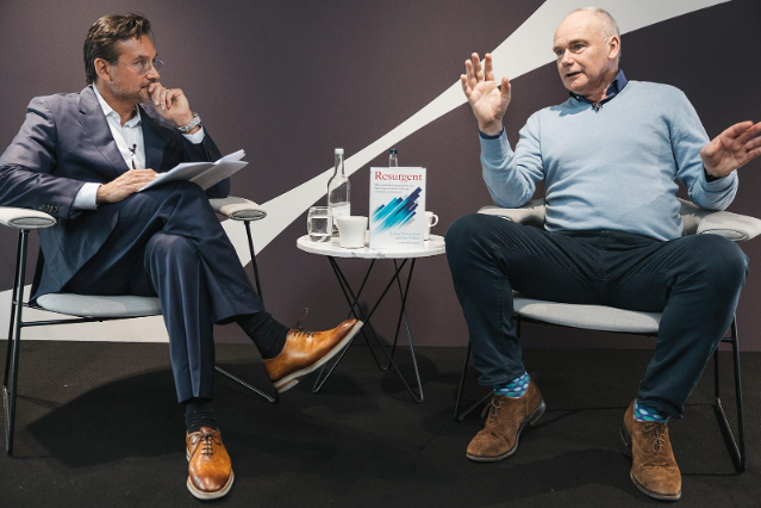
“Just because something takes a long time does not make it easier.” — John Fallon
That slow pace creates a trap. Organizations start borrowing identities.
“We want to become the Netflix of this or the Spotify of that,” John said. “Instead of asking what it is we actually do that is of enduring value.”
Transformation fails when ambition outruns fit.
Leverage Your Strengths
Pearson’s transformation is often described as a shift from print to digital. That misses the real story.
When John became CEO, Pearson sold roughly 20 million US college textbooks a year. Ten years later, that number had dropped below one million. Two billion dollars in revenue disappeared. Forty percent of sales and 65 percent of profits vanished.
Yet the company survived and returned to growth.
Why? Because Pearson clarified its job to be done.
“The job to be done was not publishing textbooks,” John said. “The job to be done was empowering people to progress in their lives through learning.”
Once that was clear, Pearson could lower prices, move to access models, and redesign the business without losing its identity.
John made a critical distinction. What you monetize is not always what makes you strong.
In Pearson’s case, enduring value lived in trusted relationships, assessment credibility, and the ability to structure knowledge. The textbook was simply one expression of that value.
“The textbook just happened to be the way we monetized it,” he said.
If leaders confuse interface with value, they defend the wrong things.
Purpose Matters Most
John shared a personal story about being diagnosed with throat cancer years before becoming CEO. During treatment, he learned a phrase attributed to Martin Luther: the cross tests everything.
He applied that idea to organizations in disruption.
“Moments of crisis strip away the superficialities and reveal who we are at our core,” John said. “Disruption does the same thing to a company.”
Purpose, in this context, is not motivation. It is stability.
During Pearson’s hardest years, the share price collapsed, dividends were cut, and restructuring was constant. What held people was not optimism, but meaning.
“Profits sustain a company,” John said. “They do not define it. But when profits come under pressure, purpose matters even more.”
Purpose also creates patience. It explains why today’s pain is connected to tomorrow’s value. Without that link, trust erodes quickly.
A Leadership Checklist
John did not offer a framework. He offered guidance earned the hard way. Here is a short list of questions leaders should be asking now:
- What job do we truly exist to do? If your main product disappeared, what would customers still rely on you for?
- Are we protecting products or building capabilities? Capabilities endure. Formats do not.
- Are we mistaking slow change for safety? Long disruption is harder to lead than sudden shock.
- Where are we borrowing someone else’s identity? What language or models do not actually fit us?
- Can people see why the pain is worth it? Purpose should explain tradeoffs, not decorate them.
- When does disagreement happen? Early disagreement enables real commitment.
- Are you focused on work only you can do? Busy is easy. Leadership is selective.
These are operational questions. Answering them honestly is often the difference between performative change and real progress.
The Real Work of Transformation
Pearson’s story is not about chasing disruption. It is about earning longevity.
It starts with knowing who you are before deciding how to change. It requires separating what you sell from why you matter. It demands doing the job that needs to be done, not the one that gets applause.
As John reminded us, paraphrasing Bob Dylan, “If you’re not busy being born, you’re busy dying.”
The leaders who outthink disruption are not the loudest or the fastest. They are the ones who can clearly define their job to be done and reorganize around delivering it as conditions change.
If these questions resonate, you are already thinking like an Outthinker.
Click here to hear the full conversation with John Fallon, recorded live at LHH’s Executive Exchange Conference in London.
Outthinker Networks is a global peer group of heads of strategy, innovation, and transformation at $1B+ companies who are determined to move their organizations to the next level. Members engage in curated learning, practical conversations, and networking opportunities to be more successful in performing their roles, solving their top challenges, and keeping their organizations ahead of the pace of disruption.
Authors
