
The Keys We Carry
Listen to an AI audio recording of this newsletter
I’ve been thinking about keys lately.
My recent move gave me an opportunity to sort through the collection I’ve accumulated over the years. House keys, car fobs, office keys, membership tags, even keys to storage units.
Some of the keys opened doors I used every day. Others belonged to places I rarely visited. A few memorialized chapters of my past.
It’s strange how much meaning we attach to objects we barely notice.
A house key represents more than access to a building. It can mean ownership, safety, and belonging. An office key signals permission and responsibility. A membership fob connects us to a community we’ve chosen to join. And a storage unit key? That’s access to the things we’ve decided are worth keeping, even if we’re not quite sure where they belong anymore.
Different keys. Different meanings.
But all of them represent some combination of four powerful ideas: access, permission, ownership, and belonging.
And I’ve been wondering whether we spend too much time thinking about the doors our keys open and not enough time considering what happens once we’re inside.
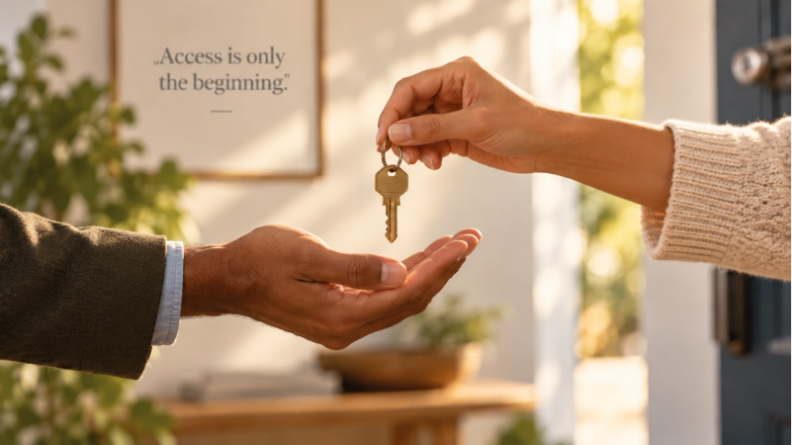
Access Is Only the Beginning
Think about the last time someone handed you a key.
Maybe it was your first apartment, your new office, or the home of someone you love.
The physical exchange was simple, but the meaning depended entirely on the relationship.
A hotel key gives you temporary permission. A house key can signal ownership. An office key may come with responsibility. And when someone you love gives you a key to their home, it’s often an expression of trust.
Yet a key doesn’t necessarily give you all of these things.
You can have access to a club without feeling part of its community. You can have permission to enter an office without having a voice in what happens there. You can own a house without ever feeling at home.
The distinction is subtle, but important.
We live in a world that makes access easier than ever. We can join professional networks, subscribe to communities, attend exclusive events, and connect with people around the globe.
But being admitted isn’t the same as being included. And being included isn’t necessarily the same as belonging.
Belonging grows through shared experiences, mutual trust, and the feeling that your presence matters. It isn’t something a key can guarantee.
A Chain That Isn’t a Chain
There’s something else interesting about the keychain that keeps all those aspects of your life together.
Despite its name, the most familiar version isn’t a chain at all. It’s a circle.
No beginning. No end. Your house key sits beside your car fob, which sits beside your office key. Each opens a different part of your life, but all share the same ring.
In a way, a keychain is a physical map of the worlds we move between.
And those worlds are rarely as separate as we imagine.
A friendship formed at work becomes a lifelong personal relationship. Someone you meet through a shared interest introduces you to an entirely new opportunity. A casual conversation creates a connection that matters years later.
I’ve spent years exploring how innovation often emerges when people connect ideas, resources, and capabilities that previously existed apart.
The same principle applies to our lives.
We tend to organize our relationships into categories: family, friends, colleagues, neighbors, communities. But some of the most meaningful experiences occur when those circles overlap.
The real value of a network isn’t simply the number of people who have access to it. It’s what becomes possible when those people connect.
The Choice to Add a Key
Moving has a way of making you reconsider what you carry.
Some keys no longer have a purpose. Others need to be returned. New ones are added. And a few, like the key to a storage unit, represent things you’re not quite ready to leave behind.
But have you ever noticed how much effort it takes to remove a key from one of those metal rings?
You have to pry the ring apart and carefully work the key around the circle. Adding a new key takes the same deliberate effort.
It’s a small inconvenience, but I like the symbolism.
We don’t usually add or remove keys by accident. We make a conscious choice about what deserves a place on the ring.
In life, we make similar choices about the communities we join, the responsibilities we accept, and the relationships in which we invest our time.
Sometimes we continue carrying keys to doors we no longer need to open. Other times, we hesitate to accept a new key because we understand that access can also bring responsibility.
But perhaps the more interesting question isn’t which keys we choose to carry.
It’s who gets to decide who receives one.
The Keys We Give Away
Most of us spend a significant part of our lives pursuing access.
We want to get into the right school, join the right organization, meet the right people, or be invited into the right room.
But eventually, we find ourselves in a different position.
We’re the ones who can make the introduction. Extend the invitation. Welcome someone into a community. Give someone an opportunity they might not otherwise have had.
We become the people holding the keys.
In my work with Outthinker, I’ve seen how powerful it can be when people don’t simply use their networks for personal advantage, but actively create connections for others.
Sometimes the most valuable thing we can offer someone isn’t advice, expertise, or even a solution.
It’s access.
An introduction that changes their trajectory. An invitation that helps them feel included. An opportunity to contribute that eventually becomes a genuine sense of belonging.
Of course, giving someone access doesn’t automatically create that belonging. What happens after the door opens still matters.
But someone has to open it.
And that brings me back to the ordinary keychain.
It’s a collection of small objects representing the places we’re permitted to enter, the things we’ve taken responsibility for, and the people who have trusted us enough to let us in.
But it might also remind us of something larger.
We spend so much time thinking about which doors we want to open that we sometimes forget we have the power to open doors for others.
The keys we carry tell a story about where we belong.
The keys we give away can help shape where someone else belongs.
Find your access and sense of belonging by joining Outthinker today.
Outthinker Networks is a global peer group of heads of strategy, innovation, and transformation at $1B+ companies who are determined to move their organizations to the next level. Members engage in curated learning, practical conversations, and networking opportunities to be more successful in performing their roles, solving their top challenges, and keeping their organizations ahead of the pace of disruption.
Authors
