
The Power of Connection
Listen to an AI audio recording of this newsletter
For days, I practiced. I rehearsed the words, refined the transitions, and challenged myself to distill years of research and experience into a message that could resonate in just a few minutes.
I’ve spoken on hundreds of stages throughout my career, but this specific spotlight always feels different.
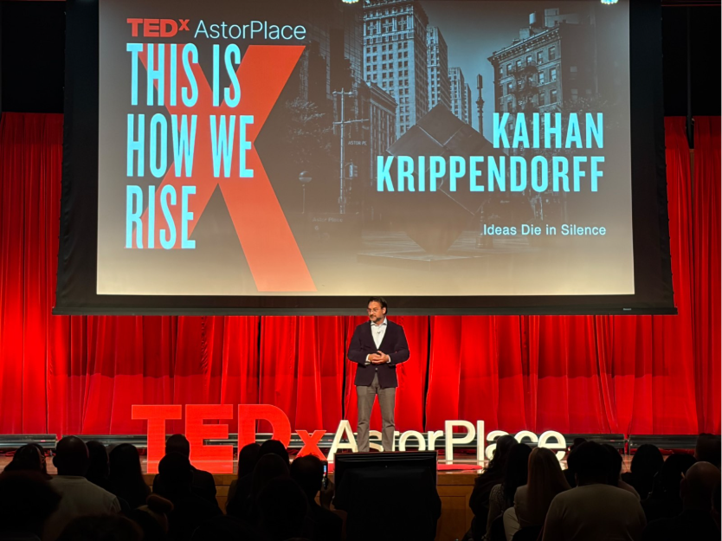
Standing on the TEDx Astor Place stage in New York City, I felt both the weight of the opportunity and the excitement of sharing an idea I believe deeply in.
The dress rehearsal had been surprisingly lighthearted. There was laughter, encouragement, and a sense of camaraderie among the speakers. But beneath that relaxed atmosphere was an understanding that we were preparing for something important. Each of us had something we wanted the world to hear.
The timing felt almost destined.
I’d arrived in New York fresh from London, where the Thinkers50 gathering and our Outthinker Roundtable had brought together some of the world’s leading thinkers, strategists, and CEOs to exchange ideas, challenge assumptions, and explore new possibilities.
Now, here I was, preparing to deliver a TEDx talk about the very thing that makes those gatherings so powerful: connection.
Connecting people, ideas, and opportunities has been at the heart of my work for decades. It’s what I try to do every day with the leaders I advise, the audiences I speak to, and the community we’ve built through Outthinker.
Over the years, I’ve explored this conviction from different angles. In Ideas Die in Silence, I examined how much innovation is lost when people hesitate to share what they know. In Connect the Dots. Spark a Revolution, I explored how solutions often remain hidden in unexpected places. And in research published in Harvard Business Review, my coauthors and I examined how organizations can systematically connect ideas with the people who need them.
Each investigation led me back to the same conclusion: Our greatest innovation challenge may not be a shortage of ideas, but a shortage of connections.
That was the message I wanted to bring to TEDx Astor Place.
What If the Answer Already Exists?
We tend to celebrate innovation as the act of creating something entirely new.
We admire the inventors who see what others cannot, the brilliant minds who develop solutions from scratch. I’ve spent much of my career studying and teaching the principles behind that kind of breakthrough thinking.
But what if we’ve been asking the wrong question?
What if the answer to most of our hardest problems already exists, just somewhere we haven’t thought to look?
I spent a year interviewing nearly 100 innovation leaders, including chief innovation, transformation, and strategy officers, representing organizations ranging from Amazon to the World Health Organization. I asked them how often they discovered that a solution to a problem already existed when they shared that problem broadly across their organizations and networks.
Their answer is shocking.
More than 70% of the time. For five out of seven innovation problems, a solution is already out there.
Yet when I asked how often they actually stopped to look for those existing solutions, the answer was almost never, just 10% of the time.
Think about that. We spend enormous amounts of time, talent, and money inventing answers that someone else may have already discovered. Indeed, globally, we invest $3 trillion annually in R&D and employ 9 million people full time (that is the population of London).
And yet, the most important missing ingredient isn’t invention. It’s connection.
Why Great Ideas Stay Hidden
This finding reminded me of another troubling pattern my research had uncovered.
In Ideas Die in Silence, I explored research showing that 80% of employees share less than half of their ideas. Some doubt their ideas are good enough. Others fear they won’t be taken seriously. Still others simply aren’t asked.
The result is an extraordinary amount of unrealized potential.
These two research findings point to different sides of the same problem: Sometimes the solution exists, but no one knows where to find it. Other times, someone has the answer but never speaks up.
The consequences can extend far beyond missed business opportunities. When problems remain confined to the industries or experts we assume should solve them, answers that already exist elsewhere can go undiscovered for years.
Consider what happened in the aftermath of the Exxon Valdez oil spill.
For 18 years after the Exxon Valdez disaster, cleanup responders struggled with oil becoming too thick to pump in cold conditions. When the problem was finally shared through an open innovation platform called InnoCentive—now owned by Wazoku, and led by my friend Simon Hill—the solution came from an unexpected source: a man named James Davis who had no experience in the oil industry but had spent time pouring concrete over the summer.
He knew what every concrete worker in the world knew: that applying vibration to setting concrete can get it flowing again, and the same approach could also help move thickened oil in the cold water.
The answer wasn’t hidden in some sophisticated new invention. It was hiding in another industry.
This example reveals something important: innovation isn’t always about creating something new. Sometimes it’s about recognizing the value of something familiar in an unfamiliar context.
But that kind of discovery requires two things: someone willing to ask a question beyond their usual circle and someone willing to share what they know.
Seven People. Seven Fields. Seven Days.
This was the challenge I wanted to leave with the TEDx audience.
The next time you encounter a problem that seems impossible to solve, resist the instinct to immediately invent something new.
Instead, describe the problem in simple terms, without the technical language or industry assumptions that might limit how others see it.
Then ask seven people from seven different fields how they might approach it. Reach out to one person each day for a week.
You might discover that someone in an entirely different profession has already solved a version of your problem.
And if you happen to be the person holding an idea that could help someone else, don’t underestimate the importance of speaking up.
As I left the TEDx stage, I found myself thinking about the conversations I’d had in London, the leaders I’ve interviewed over the years, and the countless connections that have shaped my own thinking.
The experience reinforced something I’ve come to believe more strongly with each passing year: progress doesn’t depend solely on how many brilliant ideas we create. It depends on how effectively we bring the ideas, people, and problems that already exist together.
Somewhere, someone may already have the answer you’re looking for.
The only thing standing between you and that answer may be silence.
Be a part of the conversation and find unexpected solutions by joining Outthinker today.
Outthinker Networks is a global peer group of heads of strategy, innovation, and transformation at $1B+ companies who are determined to move their organizations to the next level. Members engage in curated learning, practical conversations, and networking opportunities to be more successful in performing their roles, solving their top challenges, and keeping their organizations ahead of the pace of disruption.
Authors
